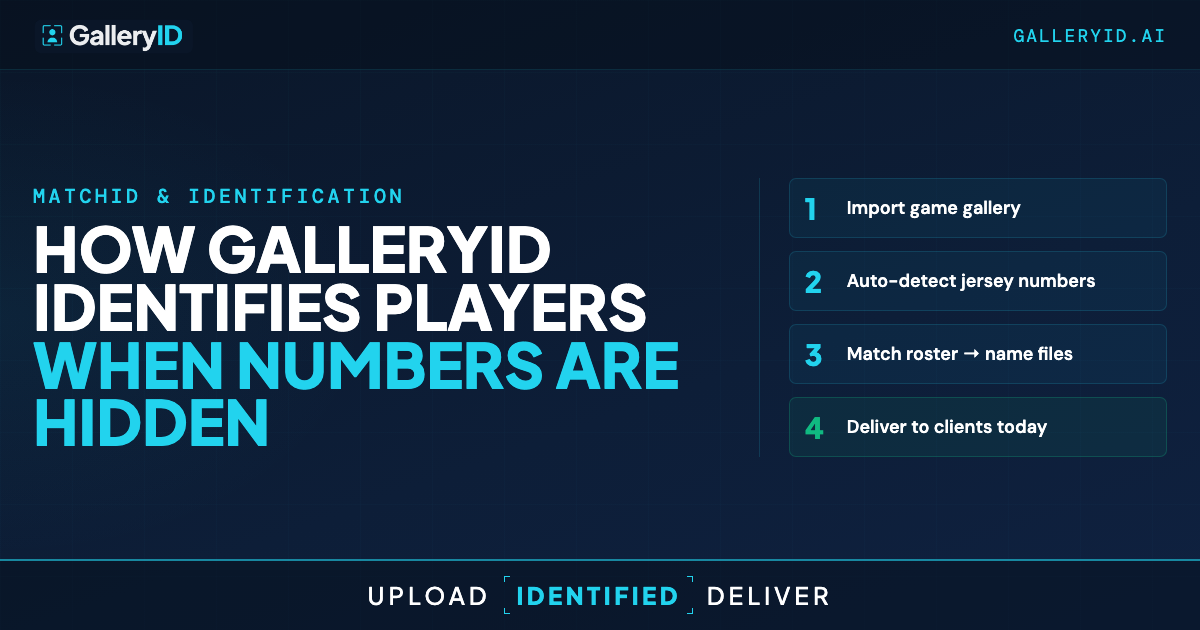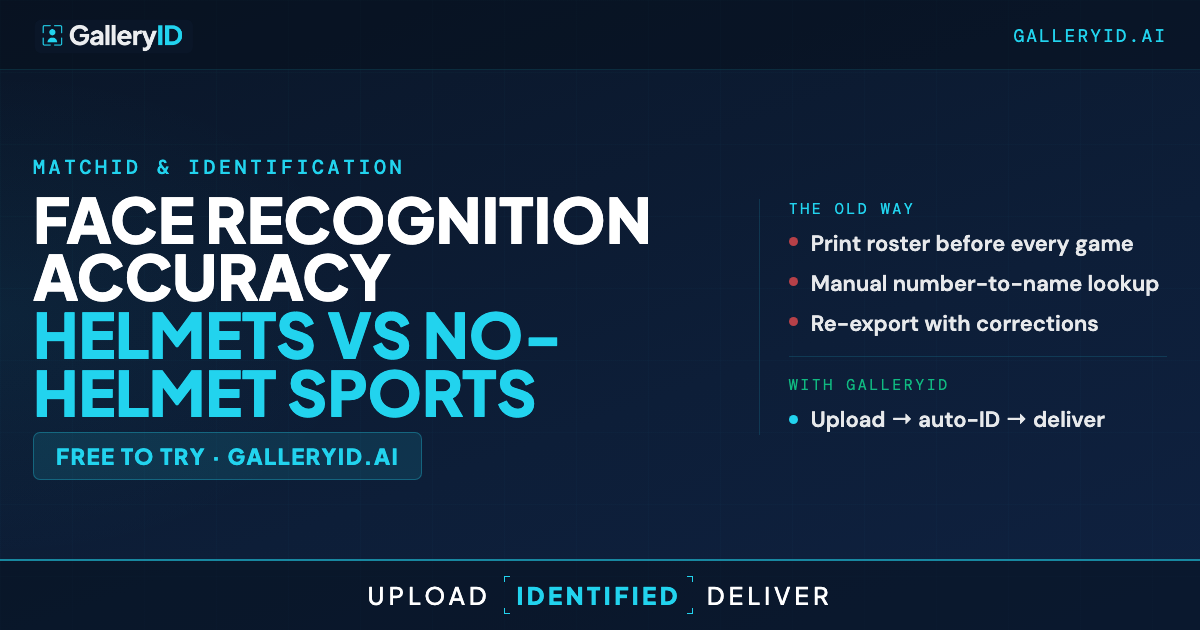
The Sport Changes the Accuracy. Plan Accordingly.
If you cover basketball, soccer, and football across the same week, gallery delivery times shift dramatically by sport. The reason isn't lighting or pace of play. It's face recognition accuracy across helmeted versus no-helmet sports. GalleryID handles each context with the same MatchID pipeline, but what it leans on shifts and so do your expectations.
Face-visible sports are easier. Helmet sports are harder. Both are workable with the right setup. The trick is knowing where auto-match carries the load and where the review queue picks up the rest.
No-Helmet Sports: The Easiest Cases
Basketball, soccer, volleyball, baseball, and softball are the strongest cases for face recognition. The face is visible most of the play, and the roster headshot lines up with how the athlete looks on the court or pitch.
Static frames and clear headshots match cleanly. Action frames with motion blur, sweat, or extreme angles are harder, and the confidence-flagged review queue picks those up. The work for the photographer is confirming the uncertain ones, not validating the obvious ones.
Helmet Sports: Football, Lacrosse, Hockey
Helmets cover most of the face during action. Football helmets and lacrosse helmets are particularly dense. Hockey cages drop coverage too. In a tight in-play crop, there isn't much for face recognition to work with, and pretending otherwise sets the wrong expectation.
What still works in these sports is everything around the helmeted action. Sideline frames. Bench reactions. Helmet-off moments after the play. Pre-game and post-game portraits. Those frames carry face data MatchID can match against the roster headshot, and they're often the photos parents want anyway.
For the helmeted action itself, jersey color narrows the candidate pool to the correct team. Frames where the face isn't enough go to the review queue. It's a different rhythm than basketball, but it's not the unsolvable case it can feel like at midnight.
Plan for the Sport in Front of You
Knowing where MatchID excels and where it earns its keep on the harder calls is what separates a smooth post-game pass from a frustrating one. Upload one good headshot per athlete with the roster. Make sure both teams are uploaded so jersey color can narrow the pool. Trust the review queue when it flags something. The downloads carry approved names through the XMP metadata into Photo Mechanic and Lightroom.
Your roster does the work. GalleryID does the matching.
Frequently Asked Questions
Which sports work best with face recognition?
Face-visible sports work best: basketball, soccer, volleyball, baseball, softball. Helmet sports like football, lacrosse, and hockey are harder during in-play action, but recoverable via sideline frames, bench reactions, and helmet-off moments.
Should I take pre-season helmet-off portraits for helmet sports?
Yes. A clean helmet-off headshot indexes the face in a way that survives partial coverage during action and matches cleanly on sideline frames. The setup investment pays back across the whole season.
How does jersey color help?
When both teams' rosters are uploaded for the gallery, MatchID detects the jersey color in each photo and narrows the candidate pool to the team wearing that color. Smaller pool, higher confidence, fewer cross-team mistakes.
What about frames where the face isn't visible at all?
Those go to the review queue where the photographer confirms the identification. Auto-match doesn't guess on frames without face data, so uncertain identifications don't get written into the file.
Does lighting affect accuracy?
Yes, but less than helmet coverage. Indoor venues with consistent lighting help. Outdoor games with side lighting or strong shadows drop confidence on individual frames. The review queue flags the low-confidence ones either way.